 TrustStudy
How-to
How to Study With Practice Quizzes Using Active Recall
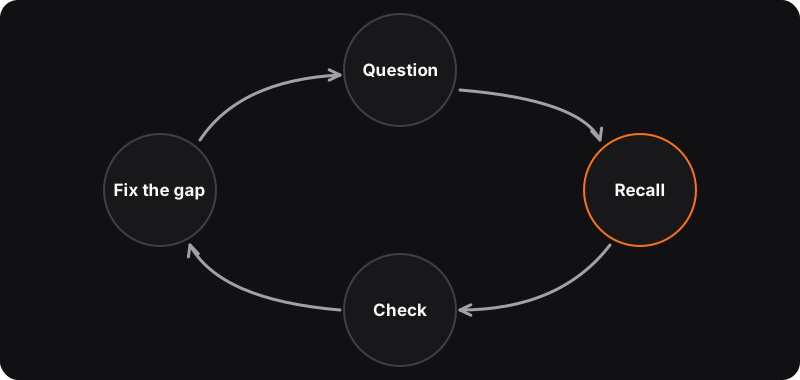
Studying with practice quizzes works because it forces you to pull answers out of memory, which is what makes them stick. The method: answer each question on your own first, check right away, read why the right answer is right, and redo the questions you missed a few days later. It beats rereading notes for most subjects.
Why quizzing yourself works
Rereading feels productive because the material looks familiar. But recognizing something isn’t the same as remembering it. When you try to answer a question before seeing the answer, your brain has to retrieve the information, and that effort is what strengthens the memory. Researchers call this the testing effect, or retrieval practice, and it’s one of the most consistently supported study techniques.
Step 1: find (or make) questions
- Your course: end-of-chapter questions, past papers, practice tests from your teacher.
- Online practice sets for your subject or exam.
- Make your own: turn each heading of your notes into a question. “Causes of the French Revolution” becomes “What were three causes of the French Revolution?”
- Ask an AI to write questions from your notes: “Write 10 multiple-choice questions on this text, answers at the end.”
Step 2: answer on your own first
- Read the question and cover the options if it’s multiple choice. Try to recall the answer before looking.
- Commit: write or say your answer, even if you’re unsure.
- Rate your confidence: sure, unsure, guess.
This “commit first” step is the one people skip, and it’s where the learning happens.
Step 3: check right away and read the why
Check each answer immediately, not at the end of a 50-question set. Then, for every mistake and every lucky guess, read why the right answer is right. A bare “b” teaches you almost nothing; an explanation fixes the misunderstanding.
No answer key, or the key gives letters without explanations? That’s where an AI explanation helps. See how to get AI explanations for quiz questions.
Step 4: keep a mistake list
| Question | My answer | Right answer | Why I got it wrong |
|---|---|---|---|
| Capital of Australia? | Sydney | Canberra | Confused biggest city with capital |
The last column is the useful one. Patterns appear fast: “I mix up X and Y”, “I don’t read negatives in questions”.
Step 5: redo missed questions later
Redo your mistake list after 1 day, 3 days and a week. Spacing the reviews out is what moves things into long-term memory. Plan the dates with the free spaced repetition planner, and read why you forget what you study.
A 30-minute quiz session
- 5 min: redo yesterday’s mistakes
- 20 min: new questions, answer first, check immediately, read the why
- 5 min: update the mistake list
Where TrustStudy fits
TrustStudy is a Chrome extension that sits on the page where your practice questions are. After you’ve committed to your answer, press Alt+X to reveal the AI’s answer, with the reasoning when you want it. It’s built for step 3: checking quickly and understanding why, without copy-pasting into another tab. Use it on practice material, never on a graded test.