 TrustStudy
Fix
Forgetting What You Study the Next Day? 6 Fixes
Forgetting most of what you studied within days is normal: it’s called the forgetting curve. You beat it by changing how you study, not how long: quiz yourself instead of rereading, review at increasing intervals (1 day, 3 days, a week…), mix topics, sleep, and explain ideas in your own words.
Why you forget
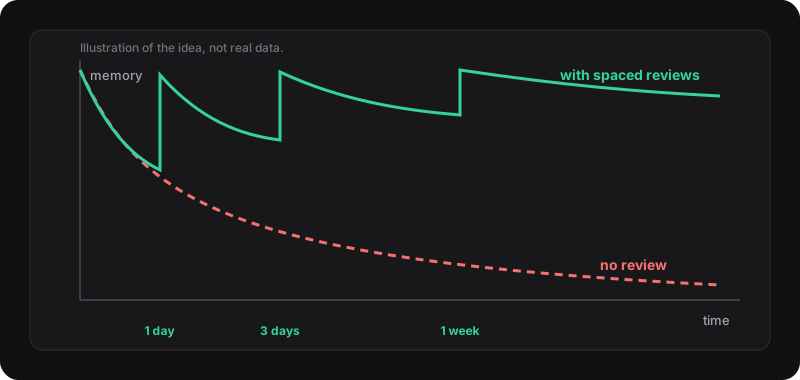
In the 1880s, Hermann Ebbinghaus measured how quickly he forgot lists he had learned. Memory dropped steeply in the first days, then more slowly. Later research confirmed the general shape: without review, much of what you learn fades quickly. The good news: every time you successfully recall something, it fades more slowly afterwards.
1. Quiz yourself instead of rereading
Rereading creates familiarity, not memory. Closing the book and trying to answer questions (active recall) is far more effective. How to do it: studying with practice quizzes.
2. Space your reviews
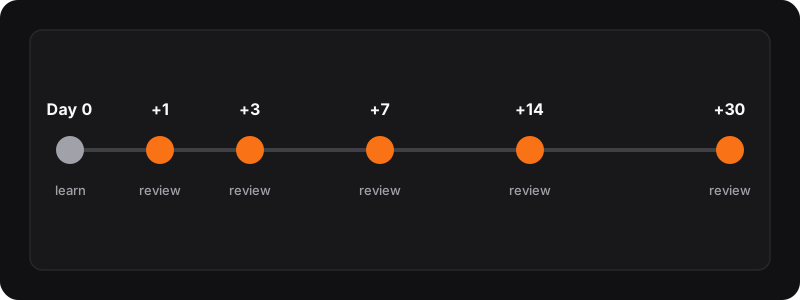
Review after about 1 day, 3 days, 7 days, 14 days and 30 days. Each review is shorter than the last, and the material sticks for longer. Get your exact dates from the free spaced repetition planner.
3. Mix topics (interleaving)
Doing 20 problems of the same type in a row feels smooth but teaches you to apply one recipe. Mixing problem types forces you to recognize which method fits, which is what exams ask.
4. Explain it in your own words
Teach the idea to a friend, a rubber duck or an AI (“Here’s my explanation of X, what did I get wrong?”). Gaps show up immediately. More ways in how to use AI to study.
5. Sleep on it
Sleep plays an important role in consolidating memories. An all-nighter before an exam trades long-term memory for a few extra hours of cramming. Study, sleep, then do a short recall session in the morning.
6. Fix mistakes, not just scores
After a quiz, the score matters less than the mistakes. For each wrong answer, understand why (an explanation helps: see getting AI explanations for quiz questions), write it in a mistake list, and redo it at your next review.
What a week of studying looks like
| Day | New material | Reviews |
|---|---|---|
| Mon | Chapter 1 | none |
| Tue | Chapter 2 | Ch. 1 (day 1) |
| Wed | Chapter 3 | Ch. 2 (day 1) |
| Thu | Chapter 4 | Ch. 1 (day 3), Ch. 3 (day 1) |
| Fri | Practice quiz, mixed | Ch. 2 (day 3), Ch. 4 (day 1) |
Reviews are short: 10 to 15 minutes of quizzing, not rereading whole chapters.
A tool for the “check” step
TrustStudy fits into fix 1 and fix 6: on a practice quiz page, answer first, then press Alt+X to reveal the AI’s answer with its reasoning. Fast feedback makes quizzing yourself less tedious, so you actually do it. For practice material only.