 TrustGeo
How-to
GeoGuessr Country Clues to Learn First: Lines, Signs, Plates
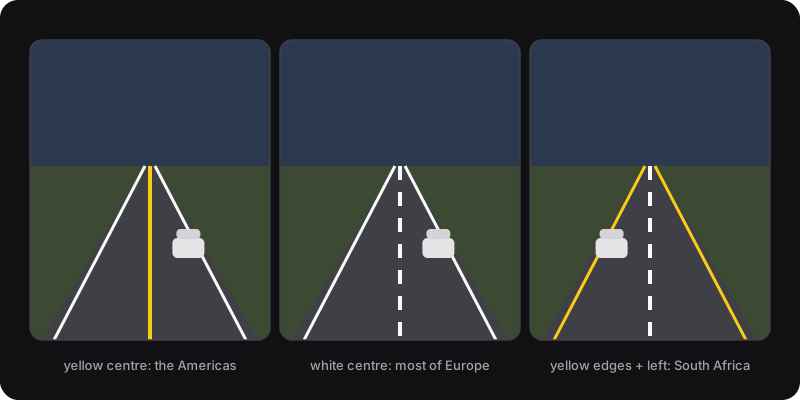
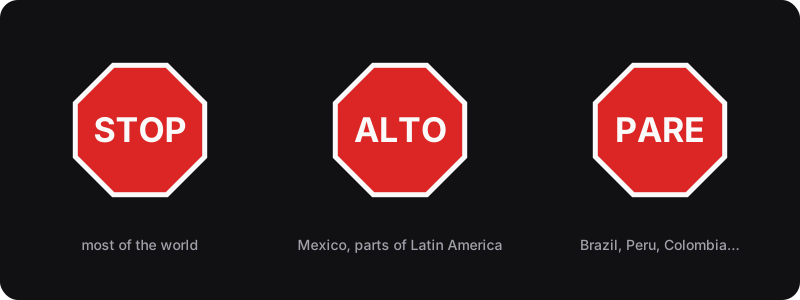
The clues worth learning first are the ones that eliminate the most countries: driving side, road line colors (yellow centre lines in the Americas, white in most of Europe), the word on stop signs (STOP, ALTO, PARE), license plate colors, and the script and web domains on signs. Learn them one at a time, and check details in a country guide like Plonk It.
A note on accuracy
Rules have exceptions: older roads, regional variations, new coverage. Treat every clue as “likely”, not “certain”, and combine two or three before committing.
1. Driving side
About a third of the world drives on the left. In GeoGuessr coverage, left-driving places include the United Kingdom, Ireland, Malta, Cyprus, Japan, Thailand, Malaysia, Singapore, Indonesia, India, Sri Lanka, Bangladesh, Bhutan, Hong Kong, Australia, New Zealand, South Africa, Lesotho, Eswatini, Botswana, Kenya and Uganda. Almost everywhere else drives on the right. Watch the surprises: Rwanda drives on the right even though its neighbours Uganda and Kenya drive on the left.
Drill it with the free driving side quiz.
2. Road line colors
- Yellow centre lines: USA, Canada, Mexico and much of South America.
- White centre lines: most of Europe, Russia, and many other countries.
- Yellow centre lines in Europe: Norway and Finland are the classic exceptions.
- Yellow edge lines: a well-known South Africa clue (often with white centre lines and left-hand driving).
3. Stop signs
The red octagon is almost universal, but the word changes:
- STOP: most of Europe, North America, much of Asia and Africa.
- ALTO: Mexico and several Spanish-speaking countries.
- PARE: Brazil and some Spanish-speaking countries like Peru and Colombia.
- Local versions: Japan uses an inverted red triangle with 止まれ.
4. License plates
Plates are often blurred, but their color and shape still show:
- Blue strip on the left: European Union countries (and some others).
- Yellow plates front and back: the Netherlands and Luxembourg.
- White front, yellow rear: the United Kingdom.
- Yellow plates are also typical of Israel and Colombia.
5. Script, language and web domains
- Script narrows things instantly: Cyrillic, Greek, Thai, Hebrew, Arabic, Korean, Japanese.
- Special letters in Latin script: ñ (Spanish), ã/õ (Portuguese), ø/å (Danish, Norwegian), ő/ű (Hungarian), ş/ğ (Turkish), ł (Polish).
- Domains and phone numbers on shop signs and vans:
.de,.pl,.ro,.com.br,.co.za… and country calling codes like +48 or +55.
6. Next level: bollards, poles and car details
Once the basics are automatic, experienced players learn country-specific details: the roadside bollards (small posts along the road, whose shape and colors vary by country), utility poles, and even parts of the Google camera car visible in some countries’ coverage. These are best learned from a reference with photos, such as Plonk It, one country at a time.
How to actually remember all this
- Learn one clue family per week (driving side, then lines, then signs…).
- In every game, check that clue first.
- Review rounds where it would have helped. Here’s the practice loop.
When you review a round in single-player, TrustGeo can show you the exact place and region, which makes it easy to connect the clue you saw with the country it belongs to. Guess first, check after.