 TrustGeo
Manual vs extension
How to Get Better at GeoGuessr: A Practice Method That Works
You get better at GeoGuessr by reviewing your rounds, not just by playing more. Make your own guess, then look at where the round really was, find the one clue you missed (driving side, road lines, script, vegetation), and practice spotting it. You can review by hand on GeoGuessr’s results screen, or use a companion like TrustGeo in single-player to see the exact place and region while you study.
Why playing more isn’t enough
Most players plateau because they play round after round without looking back. You click “next”, forget the location, and make the same mistake a week later. Strong players do the opposite: every bad guess becomes a lesson. They don’t memorize the world. They learn a few clues that rule out whole continents in seconds.
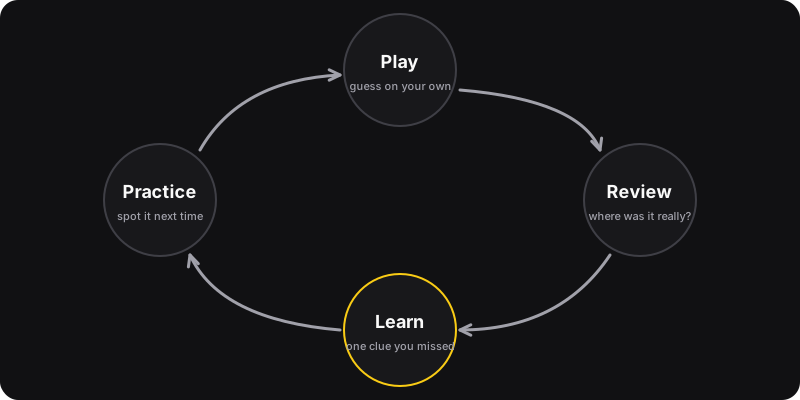
The four-step practice loop
- Play and commit. Make your own guess from what you see. No help, no peeking.
- Review. Look at where the round really was: country, region, and how far off you were.
- Learn one clue. Ask “what in the scene should have told me?” Pick one thing: which side cars drive on, the road line colors, a script, a stop sign, the soil.
- Practice it. Next games, look for that clue first. When it’s automatic, pick the next one.
One clue per session is enough. Ten sessions later you have ten reflexes, and that’s a huge jump in score.
Method 1: review by hand (free)
- Play in single-player or a casual mode, so you can take your time.
- After each round, study the results map: where was it, where did you click?
- Keep a notes file (or a spreadsheet) with three columns: round location, my guess, clue I missed.
- Look the clue up in a country guide like Plonk It to understand it properly.
- Once a week, reread your notes. Patterns jump out (“I always confuse these two countries”).
This costs nothing and works. The slow part is that the results screen only shows a point on a map; you often have to search to find the region or the town, and the details of the place.
Method 2: review faster with TrustGeo (single-player)
TrustGeo is a Chrome extension that shows the location of the current round in a side panel: coordinates, a map, and the place name (region, country) through reverse geocoding. Used for practice, it speeds up the review step:
- Start a single-player game or a practice map on GeoGuessr or OpenGuessr.
- Look at the scene and decide on your own guess first. Write it down if you’re serious about it.
- Open the TrustGeo side panel and click GUESS to see where the round really is, with the region and country name.
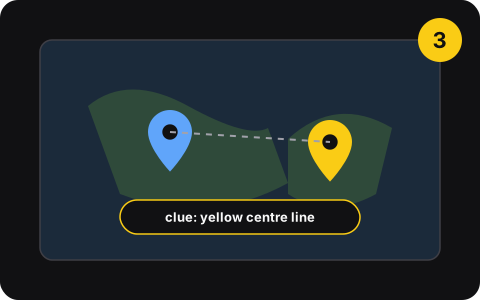
- Compare with your guess, then find the clue you missed in the scene while you’re still looking at it. That’s the big advantage over reviewing afterwards.
- Note the clue, make your guess, move on.
Fair play
Use TrustGeo to study in single-player or on practice maps. Using it in ranked games, duels, battle royale or any match against other people gives you an unfair advantage, breaks GeoGuessr’s rules, and can get your account banned. It also doesn’t teach you anything if it guesses for you: the learning only happens when you guess first.
What to learn first
Learn clues in order of how much they rule out:
- Driving side: left or right halves the world in a second. Try the driving side quiz.
- Script and language on signs: Cyrillic, Thai, Hebrew, Greek, Latin alphabet with special letters.
- Road lines: yellow centre lines in the Americas, white in most of Europe.
- Hemisphere from the sun: in the southern hemisphere the sun is in the northern part of the sky.
- Country-specific details: bollards, plates, poles. That’s for later.
The details are in GeoGuessr country clues to learn first, and the basics in GeoGuessr tips for beginners.
A 20-minute routine
- 5 minutes: reread your notes and pick today’s clue
- 10 minutes: play single-player, looking for that clue first
- 5 minutes: review your three worst rounds and add one line each to your notes